STILL APPLYING. STILL HEARING NOTHING?BUILD YOUR RESUME

STILL APPLYING. STILL HEARING NOTHING?BUILD YOUR RESUME
Choose from a wide range of NEWCV resume templates and customize your NEWCV design with a single click.
FAQ
A PHP developer resume usually fails for one reason: it sounds technical without proving business value. Recruiters and hiring managers see hundreds of resumes that say things like “worked on web applications” or “used PHP and MySQL,” but never explain what the developer actually built, improved, fixed, optimized, or delivered.
In today’s US hiring market, especially for backend, Laravel, WordPress, Magento, and full stack PHP roles, companies are screening for impact, architecture understanding, framework depth, collaboration skills, and production-level experience. Your resume must prove you can contribute in a real engineering environment, not just list technologies.
The biggest mistakes include vague bullet points, outdated PHP-only stacks, missing framework keywords, ATS-breaking formatting, weak project descriptions, and no measurable results. Even strong developers get rejected because their resumes fail to communicate technical depth clearly and quickly.
This guide breaks down the exact PHP developer resume mistakes recruiters reject, why they hurt your chances, and how to fix them strategically.
Most PHP resumes fail within the first 15 to 30 seconds of review.
That does not necessarily mean the candidate lacks technical ability. It usually means the resume creates uncertainty.
Hiring managers ask themselves questions like:
What type of PHP developer is this person?
Can they work in production systems?
Have they used modern PHP frameworks?
Can they explain business impact?
Are they backend-focused, CMS-focused, e-commerce-focused, or full stack?
Can they contribute to APIs, scalability, testing, deployment, and debugging?
If the resume does not answer those questions clearly, recruiters move on quickly.
The modern PHP market is heavily segmented. A Laravel API engineer is evaluated differently from a WordPress plugin developer or Magento backend developer. Generic resumes perform poorly because hiring teams want specialization signals immediately.
This is the most common PHP developer resume mistake.
Recruiters constantly see bullets like:
“Worked on websites”
“Responsible for backend development”
“Built PHP applications”
“Maintained company systems”
These statements communicate almost nothing.
Hiring managers want to understand:
What systems you built
Which technologies you used
What problems you solved
Many PHP developers overload the skills section with tools but never show how they used them.
A recruiter may see:
PHP
Laravel
Symfony
Docker
MySQL
Redis
AWS
Git
But the experience section never validates those skills.
Many PHP resumes describe responsibilities instead of outcomes.
Responsibilities do not differentiate candidates.
Impact does.
A recruiter is trying to identify developers who improve systems, reduce problems, accelerate delivery, or support business growth.
Good PHP resumes include metrics like:
API response time improvements
Conversion rate improvements
Reduced bug counts
Faster deployment cycles
Improved uptime
Reduced infrastructure costs
Many PHP developers underestimate how ATS filtering works.
Most recruiters search resumes using highly specific technical keywords.
If those keywords are missing, the resume may never be reviewed manually.
The exact keywords depend on the role type.
Important keywords often include:
Laravel
REST API
Eloquent ORM
Queue Jobs
Redis
A visually impressive resume can destroy ATS readability.
This is extremely common among developers using resume builders with heavy graphics or multiple columns.
ATS systems often struggle with:
Icons
Text boxes
Complex tables
Multi-column layouts
Header/footer content
Graphic skill bars
Excessive color blocks
One of the fastest ways to get rejected is submitting the same generic PHP resume everywhere.
Different PHP roles prioritize very different experience.
APIs
Authentication systems
Queues
Testing
Performance optimization
Database design
Modern PHP practices
This mistake hurts junior and mid-level developers especially hard.
If you have limited production experience, recruiters need another way to validate technical ability.
Strong supplemental assets include:
GitHub repositories
Deployed applications
API projects
Open-source contributions
Portfolio websites
Technical blog posts
Personal SaaS projects
Some resumes still look frozen in 2014.
That creates immediate concern.
Recruiters now expect exposure to modern PHP practices.
Mentioning only core PHP with no frameworks
No PHP 8 experience
No Composer usage
No testing tools
No API development
No Git workflows
Many developers write technically accurate resumes that still fail because they ignore business outcomes.
Companies hire engineers to solve business problems.
Not just write code.
They want to know whether your work improved:
Revenue
Performance
Customer experience
Stability
Scalability
Efficiency
Many resumes focus only on feature development.
That is a major weakness for mid-level and senior PHP hiring.
Modern engineering teams expect developers to contribute across the software lifecycle.
Strong signals include:
PHPUnit
Pest
Integration testing
Feature testing
Test automation
Recruiters look for:
Recruiters scan resumes extremely fast.
Large paragraphs reduce readability dramatically.
Dense paragraphs:
Hide important achievements
Slow down scanning
Reduce keyword visibility
Create cognitive overload
Make technical depth harder to identify
Use concise bullets focused on:
This mistake destroys interview credibility.
Many developers stuff resumes with every technology they have touched once.
Recruiters notice this pattern constantly.
Technical interviewers often probe listed skills aggressively.
If you list:
Kubernetes
Elasticsearch
AWS
RabbitMQ
GraphQL
Terraform
You should be able to discuss:
The strongest PHP resumes typically share these characteristics:
Clear specialization positioning
Strong framework alignment
Modern PHP ecosystem experience
Quantified achievements
Business impact
Production engineering exposure
Clean ATS-friendly formatting
Technical depth with clarity
Before submitting your resume, evaluate every bullet using this framework:
Weak:
“Worked on APIs.”
Strong:
“Built Laravel REST APIs for payment processing platform.”
Weak:
“Used MySQL.”
Strong:
“Optimized MySQL queries reducing API response latency by 41%.”
Weak:
“Fixed bugs.”
Strong:
“Resolved recurring checkout bugs reducing failed transactions by 18%.”
Weak:
“Backend development.”
Strong:
“Developed Symfony microservices and REST APIs.”
Recruiters are not trying to fully evaluate your engineering ability from the resume alone.
They are trying to answer one question:
“Is this candidate worth interviewing?”
Your resume only needs to accomplish three things:
Clearly match the target role
Demonstrate credible technical depth
Show measurable impact
Most PHP resumes fail because they confuse activity with value.
Companies do not hire developers for “working on websites.”
They hire developers who improve systems, solve business problems, optimize performance, support scalability, and contribute effectively to production engineering teams.
Your resume should reflect that reality.

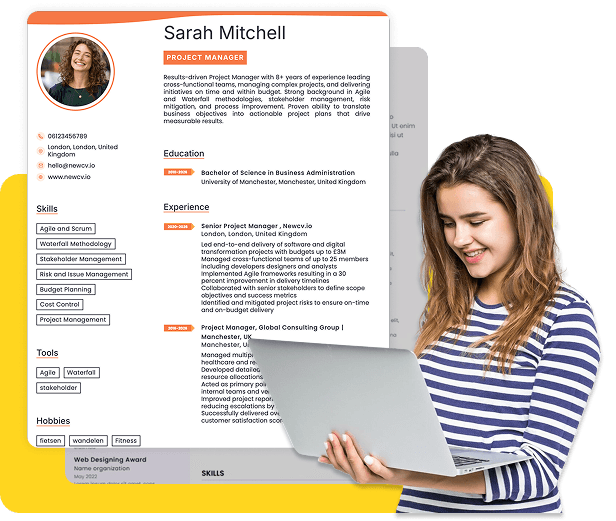
Use ATS-optimised Resume and resume templates that pass applicant tracking systems. Our Resume builder helps recruiters read, scan, and shortlist your Resume faster.

Use professional field-tested resume templates that follow the exact Resume rules employers look for.
Create Resume
Use professional field-tested resume templates that follow the exact Resume rules employers look for.
Create ResumeHow complex the work was
Whether your work produced measurable outcomes
Weak Example
“Worked on company website using PHP and MySQL.”
This sounds junior-level and gives no context.
Good Example
“Developed and maintained Laravel-based e-commerce platform serving 120K+ monthly users, reducing checkout API response times by 38% through MySQL query optimization and Redis caching.”
The second version instantly communicates:
Framework experience
Scale
Performance optimization
Backend engineering capability
Business relevance
That is how experienced engineers write resumes.
That creates credibility problems.
Recruiters assume one of two things:
The candidate copied technologies from job descriptions
The candidate has shallow exposure only
Technical hiring managers are especially skeptical of long skill lists unsupported by real project work.
Strong resumes connect technologies directly to outcomes.
For example:
“Built RESTful APIs in Laravel integrated with Stripe and Salesforce APIs.”
“Created reusable Symfony services to automate inventory synchronization across 4 warehouse systems.”
“Optimized MySQL indexes and reduced database load by 42%.”
“Implemented Docker-based local development workflow reducing onboarding time for new developers.”
The technology becomes credible because it appears inside actual engineering work.
Increased test coverage
User growth supported
Database performance gains
Faster page load times
Revenue impact
Reduced support tickets
“Reduced average page load time from 4.8 seconds to 2.1 seconds through PHP code optimization and CDN implementation.”
“Built Laravel API infrastructure supporting 2M+ monthly transactions.”
“Improved PHPUnit test coverage from 38% to 81%, reducing production regressions.”
“Automated deployment pipeline using GitHub Actions, cutting deployment time by 70%.”
Metrics immediately elevate perceived engineering maturity.
PHPUnit
Composer
MySQL
API Integration
Authentication
Middleware
Docker
Common keyword searches include:
WordPress
Custom Themes
Custom Plugins
WooCommerce
PHP
ACF
Gutenberg
REST API
Page Speed Optimization
Recruiters often search for:
Magento 2
Module Development
EAV
PHP
Composer
MySQL
Elasticsearch
API Integration
Important terms include:
Symfony
Dependency Injection
Doctrine ORM
Event Subscribers
API Platform
PHPUnit
Often include:
PHP 8
Microservices
REST APIs
GraphQL
Docker
CI/CD
AWS
Git
Testing
Caching
Security
One major mistake is using generic terminology instead of exact hiring keywords.
For example, saying “built backend services” may not rank for searches targeting “Laravel APIs” or “RESTful APIs.”
Embedded charts
When parsing fails, important keywords disappear.
Technical recruiters overwhelmingly prefer resumes that are:
Simple
Clean
Easy to scan
Text-focused
Structured logically
A clean one-column format usually performs best.
Your resume is not a design portfolio.
Engineering resumes are evaluated primarily on clarity, depth, and relevance.
Plugin development
Theme customization
WooCommerce
SEO performance
CMS scalability
Security hardening
E-commerce architecture
Module development
Catalog performance
Payment integrations
Checkout optimization
APIs
Scalability
System architecture
Database optimization
CI/CD
Distributed systems
Generic resumes fail because they dilute relevance.
Recruiters want immediate alignment with the exact role.
Code samples
Recruiters are not expecting enterprise-level architecture from entry-level candidates.
They want evidence of:
Problem-solving
Code organization
Modern tooling
Framework familiarity
Initiative
A strong Laravel API project with authentication, database relationships, testing, and deployment experience can dramatically improve interview chances.
Many developers list projects without context.
Weak Example
“Task management app using Laravel.”
Good Example
“Developed full-stack Laravel task management application with JWT authentication, role-based access control, REST APIs, and Docker deployment.”
Specificity matters.
No deployment knowledge
No containerization exposure
No modern framework experience
Strong modern indicators include:
PHP 8+
Laravel 10+
Symfony
Composer
PHPUnit
Pest
Docker
CI/CD pipelines
Redis
REST APIs
Queue systems
Cloud deployment
GitHub Actions
Caching optimization
Security implementation
Even if you are not deeply experienced, showing exposure matters.
Team productivity
“Improved checkout conversion rate by 14% through Magento payment optimization.”
“Reduced customer support tickets by implementing automated invoice processing.”
“Decreased server costs by optimizing caching strategy and reducing database load.”
This signals engineering maturity.
Authentication
Authorization
OWASP practices
Input validation
CSRF protection
Secure APIs
Important keywords include:
CI/CD
Docker
AWS
GitHub Actions
Jenkins
Linux
Nginx
Deployment automation
Candidates who show production engineering awareness stand out significantly.
Action
Technology
Outcome
Instead of:
“Responsible for maintaining backend systems and collaborating with teams while developing APIs and fixing bugs.”
Use:
Developed Laravel REST APIs supporting 500K+ monthly requests
Fixed critical production bugs reducing downtime incidents by 32%
Collaborated with frontend and DevOps teams during feature deployments
Each bullet becomes easier to scan instantly.
Use cases
Architecture
Tradeoffs
Implementation details
Real production scenarios
Weak answers damage credibility quickly.
Prioritize technologies where you can confidently discuss:
Real implementation
Challenges solved
Business context
Technical decisions
Depth beats breadth.
Scannable bullet structure
Relevant project examples
Strong keyword targeting
Evidence of collaboration and deployment experience
The resume immediately communicates where the candidate fits technically.
That clarity dramatically improves interview conversion rates.
If not, remove or rewrite it.
That single filter prevents many resume credibility problems.


 Upload Resume
 Import from Linkedin