STILL APPLYING. STILL HEARING NOTHING?BUILD YOUR RESUME

STILL APPLYING. STILL HEARING NOTHING?BUILD YOUR RESUME
Choose from a wide range of NEWCV resume templates and customize your NEWCV design with a single click.
FAQ

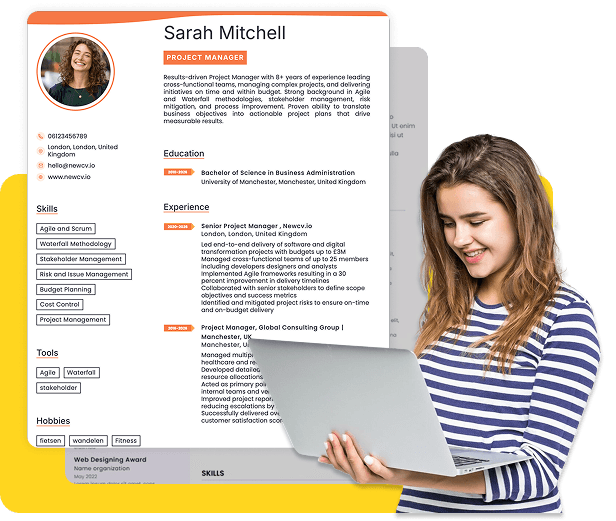
A strong .NET developer resume is not just a list of C#, ASP.NET Core, and Azure skills. Recruiters and hiring managers evaluate whether your resume proves you can build, maintain, modernize, and support production-grade Microsoft-stack applications. Most .NET resumes fail because they are too generic, overloaded with keywords, missing measurable impact, or disconnected from real engineering outcomes.
If your resume is not getting interviews, the issue is usually one of these:
Weak ATS keyword alignment
No evidence of production ownership
Missing ASP.NET Core or cloud experience
Vague bullet points with no business impact
Outdated .NET Framework-only experience
Poor recruiter readability during the 15 to 30 second scan
This guide breaks down the exact recruiter checklist, ATS ranking signals, hiring manager expectations, and resume red flags that determine whether your .NET developer resume moves forward or gets rejected.
Understanding how your resume is evaluated is the key to optimizing it correctly.
Most candidates optimize only for ATS keywords. That is a mistake.
Your resume must survive multiple layers of evaluation:
ATS keyword filtering
Recruiter scan
Technical recruiter review
Hiring manager evaluation
Technical interview screening
Architecture or coding discussion
Final team-fit and production-readiness assessment
A resume that passes ATS but fails recruiter readability still gets rejected.
A resume that impresses recruiters but lacks technical credibility fails during hiring manager review.
Strong .NET resumes align with the entire hiring funnel.
Recruiters are usually not senior engineers. They are matching resumes against hiring requirements, technical signals, and risk indicators.
Their job is to identify whether you appear interview-worthy within seconds.
These are the highest-impact recruiter signals for .NET resumes:
One of the most overlooked ranking factors is title alignment.
If the target role says:
.NET Developer
C# Developer
ASP.NET Core Developer
Backend .NET Engineer
Azure .NET Developer
Your resume should closely reflect that wording where accurate.
A mismatch between your title and the target role reduces ATS relevance and recruiter confidence.
Weak Example
“Software Engineer”
Good Example
“.NET Developer | ASP.NET Core | Azure”
This immediately improves keyword relevance and positioning.
Recruiters specifically look for current-stack relevance.
High-value signals include:
.NET 6, .NET 7, or .NET 8
ASP.NET Core
REST API development
Azure cloud services
Entity Framework Core
SQL Server
CI/CD pipelines
Azure DevOps
Docker or Kubernetes
Microservices architecture
If your resume focuses only on legacy .NET Framework applications, many recruiters assume your experience is outdated.
Most ATS systems do not “score” resumes intelligently the way people assume. However, they absolutely influence discoverability and ranking inside recruiter search systems.
Your resume needs strong semantic alignment with the job description.
High-impact ATS keywords for .NET resumes include:
.NET Developer
C#
ASP.NET Core
Web API
REST API
SQL Server
Entity Framework Core
LINQ
Azure
Azure DevOps
CI/CD
Git
Docker
Kubernetes
Microservices
xUnit
Agile
OAuth
JWT
Cloud Migration
Architecture
Secure Coding
Unit Testing
Keyword stuffing does not work anymore.
Recruiters still manually review resumes after ATS filtering. The keywords must appear naturally inside project-based accomplishments.
The strongest placement areas are:
Headline/title
Technical skills section
Recent experience bullets
Project descriptions
Certifications
Summary section
Do not hide critical skills only inside a massive skills block.
Recruiters want contextual proof.
Hiring managers evaluate technical judgment, production readiness, and engineering maturity.
They are not impressed by long technology lists without evidence of execution.
These are the biggest hiring manager signals:
Hiring managers want evidence that you worked on real systems.
Strong signals:
Enterprise applications
High-traffic APIs
Authentication systems
Cloud deployments
Modernization projects
Production debugging
Performance optimization
CI/CD automation
Senior-level .NET candidates are expected to demonstrate:
Layered architecture
Dependency injection
SOLID principles
Maintainable API design
Separation of concerns
Scalable backend patterns
You do not need to lecture about SOLID principles on your resume.
You need to show them through your work.
Weak Example
“Worked on backend development.”
Good Example
“Designed modular ASP.NET Core services using dependency injection and clean architecture principles to support scalable enterprise workflows.”
A major hidden hiring signal is database awareness.
Strong .NET developers are expected to understand:
SQL query optimization
Indexing
Stored procedures
Entity Framework performance tuning
Transaction handling
API-to-database efficiency
This matters far more than many candidates realize.
Most rejected resumes fail for predictable reasons.
This is one of the most common rejection triggers.
Weak Example
“C#, ASP.NET, SQL Server, Azure, Git”
This tells recruiters nothing about your actual capability.
Good Example
“Built ASP.NET Core APIs using C#, SQL Server, Entity Framework Core, and Azure App Service for enterprise customer workflows.”
The second version demonstrates implementation, scope, and business context.
Hiring managers want evidence of outcomes.
Strong resumes quantify:
Performance improvements
Cost savings
Deployment speed
Bug reduction
Latency reduction
Scalability improvements
Uptime improvements
Weak Example
“Improved application performance.”
Good Example
“Improved SQL query performance by 58% through indexing, stored procedure tuning, and Entity Framework optimization.”
If your resume focuses heavily on:
Web Forms
WCF only
Older .NET Framework stacks
Legacy desktop applications
Without modern .NET exposure, recruiters may assume your skills are outdated.
Modernization experience is extremely valuable in today’s market.
Many .NET roles now expect cloud familiarity.
Even backend-focused developers are increasingly expected to understand:
Azure App Services
Azure Functions
CI/CD pipelines
Infrastructure integration
Deployment workflows
Candidates who ignore deployment ownership often appear incomplete.
Recruiters instantly reject generic wording like:
Worked on applications
Responsible for development
Assisted with coding
Participated in projects
These bullets communicate almost nothing.
Use this checklist before applying.
Your resume should clearly include:
Exact target role alignment
C# experience
ASP.NET Core
REST API development
SQL Server
Entity Framework Core
Azure exposure
Git and CI/CD workflows
Agile collaboration
Testing practices
Production support experience
Modern .NET versions
Strong recruiter-friendly formatting includes:
Clean section hierarchy
ATS-readable layout
No tables or graphics
Clear spacing
Consistent formatting
Concise bullets
Logical technical grouping
Avoid:
Multi-column resume templates
Excessive design elements
Dense paragraphs
Huge keyword blocks
ATS parsing issues still happen frequently.
These improvements often produce the biggest interview increase.
Technical execution alone is not enough.
Show:
What you built
How you built it
Why it mattered
What improved
Strong bullet structure:
Action + Technology + Scope + Business Outcome
Good Example
“Automated CI/CD pipelines using Azure DevOps, reducing release time by 70% and improving deployment reliability across enterprise applications.”
This is a massive differentiator.
Recruiters trust candidates who demonstrate:
Production troubleshooting
Incident resolution
Monitoring
Logging
Performance optimization
Deployment responsibility
This signals engineering maturity.
Modernization experience is highly valuable because many companies still operate hybrid legacy environments.
Strong modernization examples:
.NET Framework to .NET 8 migrations
Monolith to microservices transitions
Cloud migration initiatives
API modernization projects
Good Example
“Migrated legacy .NET Framework applications to .NET 8, reducing technical debt and improving deployment reliability.”
Strong .NET resumes consistently use achievement-focused bullets.
Good Example
“Developed RESTful ASP.NET Core APIs using C#, SQL Server, and Entity Framework Core to support enterprise customer management workflows.”
Good Example
“Deployed scalable backend services to Azure App Service with automated CI/CD pipelines using Azure DevOps.”
Good Example
“Implemented secure authentication using Microsoft Entra ID, OAuth 2.0, JWT, and role-based access control.”
Good Example
“Reduced API response latency by 42% through query optimization, asynchronous processing, and caching improvements.”
Good Example
“Reduced production defects by 34% through unit testing, integration testing, code reviews, and improved logging.”
Recruiters prioritize:
Technical foundation
Internship experience
GitHub projects
ASP.NET Core exposure
API projects
SQL understanding
Learning potential
Junior candidates should include:
Portfolio links
GitHub repositories
Personal projects
Deployment examples
Lack of experience is acceptable.
Lack of proof is not.
Recruiters expect:
Production application ownership
API development
Database work
CI/CD familiarity
Team collaboration
Feature delivery experience
Hiring managers evaluate:
Architectural judgment
Scalability decisions
System modernization
Cloud migration leadership
Security awareness
Mentorship
Cross-functional collaboration
Senior resumes must demonstrate strategic engineering impact, not just coding ability.
These subtle details strongly influence recruiter perception.
Industry context matters.
A developer with .NET experience in:
Healthcare
FinTech
SaaS
E-commerce
Logistics
Enterprise platforms
May rank higher for similar-domain employers.
Domain familiarity reduces hiring risk.
Hiring managers increasingly value engineers who can:
Communicate clearly
Collaborate with product teams
Document systems
Participate in code reviews
Purely technical resumes sometimes fail because they lack collaboration signals.
Many weak resumes omit testing entirely.
Strong resumes reference:
Unit testing
Integration testing
xUnit or NUnit
QA collaboration
Regression prevention
This significantly improves technical credibility.
If your resume is underperforming, prioritize these upgrades first.
Add exact target role alignment
Replace vague bullets with measurable impact
Add modern .NET versions
Include ASP.NET Core and REST APIs
Add Azure or deployment exposure
Include CI/CD workflows
Mention production support ownership
Add GitHub links if junior-level
Quantify performance improvements
Remove irrelevant technologies
The biggest difference-makers are:
Clear technical specialization
Strong project context
Measurable business outcomes
Modern stack relevance
Production ownership signals
Clean formatting
Readability during fast scans
Not resume “design.”
Many resume tools oversimplify ATS optimization.
They often encourage:
Keyword stuffing
Excessive skill repetition
Generic summaries
Artificial phrasing
This creates resumes that technically match keywords but fail recruiter review.
Recruiters still evaluate:
Credibility
Readability
Technical depth
Business impact
Engineering maturity
Optimization should improve communication, not manipulate ATS systems.
The strongest .NET resumes position candidates as business-impact engineers, not just coders.
That means demonstrating:
Technical execution
Production ownership
Scalability awareness
Cloud readiness
Collaboration ability
Modern engineering practices
Measurable outcomes
The resume should answer this question clearly:
“Can this person contribute to modern production systems with minimal risk?”
If the answer feels obvious during the first recruiter scan, your interview rate rises dramatically.
Use ATS-optimised Resume and resume templates that pass applicant tracking systems. Our Resume builder helps recruiters read, scan, and shortlist your Resume faster.

Use professional field-tested resume templates that follow the exact Resume rules employers look for.
Create Resume
Use professional field-tested resume templates that follow the exact Resume rules employers look for.
Create Resume


 Upload Resume
 Import from Linkedin