STILL APPLYING. STILL HEARING NOTHING?BUILD YOUR RESUME

STILL APPLYING. STILL HEARING NOTHING?BUILD YOUR RESUME
Choose from a wide range of NEWCV resume templates and customize your NEWCV design with a single click.
FAQ

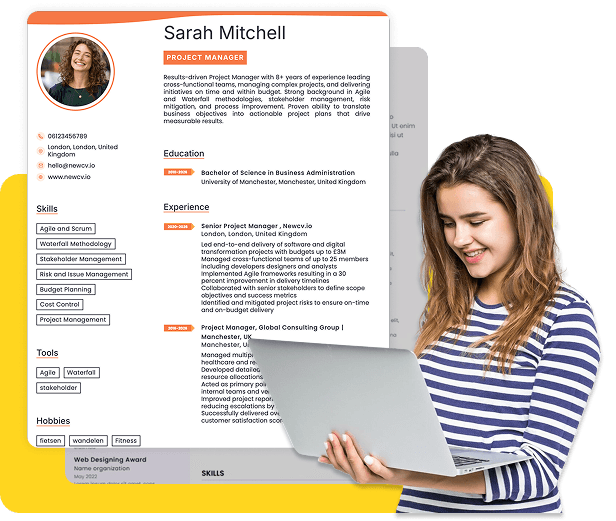
Your education section can either strengthen your credibility as a Python developer or quietly hurt your chances during resume screening. Most candidates treat it like a formality. Recruiters do not.
For Python developer roles, hiring managers use the education section to evaluate technical foundation, learning trajectory, specialization relevance, and career legitimacy. This becomes even more important for entry level developers, bootcamp graduates, self taught programmers, and career switchers competing against candidates with traditional computer science degrees.
A strong Python developer resume education section does more than list a school name. It strategically reinforces your technical positioning using relevant coursework, projects, certifications, cloud platforms, automation experience, GitHub work, and modern backend development skills.
Whether you have a computer science degree, completed a coding bootcamp, or learned Python independently, the goal is the same: make employers confident you can contribute in a real engineering environment.
Most recruiters spend only a few seconds scanning the education section unless something immediately strengthens or weakens your candidacy.
For Python developer resumes, recruiters typically evaluate:
Whether your background supports software engineering fundamentals
How closely your education aligns with backend development or Python ecosystems
Whether your training looks current or outdated
If your projects demonstrate practical coding ability
Whether you compensate for a nontraditional background with certifications or technical proof
If your education supports the complexity level of the role
For junior Python developers, the education section often carries more weight because employers have limited work history to evaluate.
For mid level and senior developers, education matters less unless:
You graduated recently
You are transitioning into Python development
You lack strong engineering experience
You are applying to enterprise or highly technical companies
The best format depends on your experience level and educational background.
Use this structure:
Degree or certification
School, university, or bootcamp provider
Graduation date or expected graduation date
Relevant coursework
Technical projects
Certifications
GitHub or portfolio links when relevant
Bachelor of Science in Computer Science
University of Texas at Dallas | Richardson, TX
Graduated: May 2024
Relevant Coursework:
Python Programming
Data Structures and Algorithms
Database Systems
Cloud Computing
API Development
Machine Learning Fundamentals
Academic Projects:
Built Flask based REST API handling 15,000+ simulated requests daily
Developed automated ETL pipeline using Python and PostgreSQL
Created AWS deployed inventory tracking application
Certifications:
AWS Certified Cloud Practitioner
Google IT Automation with Python
GitHub: github.com/johndoe
This format works because it combines formal education with technical proof.
Many resumes fail because candidates either provide too little information or overload the section with irrelevant details.
Here is what actually adds value.
Include:
Computer Science
Software Engineering
Information Systems
Data Science
Cybersecurity
Computer Engineering
Applied Mathematics
You can also include:
Coding bootcamps
Online certifications
Technical diploma programs
Professional Python training programs
Include graduation date if:
You graduated within the last 10 years
You are entry level
You recently completed a bootcamp or certification
Avoid graduation dates if:
They expose age discrimination concerns
Your experience is much stronger than your education
Coursework matters most for:
Students
Recent graduates
Junior developers
Career changers
Best coursework examples for Python developers:
Python Programming
Object Oriented Programming
Algorithms and Data Structures
API Development
Cloud Computing
Database Management
Data Engineering
Linux Systems
Artificial Intelligence
Projects dramatically improve education sections because they demonstrate applied skills.
Strong project examples include:
Backend APIs
Automation scripts
Web scraping tools
Cloud deployments
ETL pipelines
AI or machine learning projects
Database applications
Microservices architecture
Dockerized applications
Recruiters trust practical implementation more than academic labels.
Candidates with CS degrees should position themselves as technically grounded engineers, not just graduates.
Bachelor of Science in Computer Science
Arizona State University | Tempe, AZ
Graduated: May 2025
Relevant Coursework:
Advanced Python Programming
Algorithms and Complexity
Cloud Infrastructure
Operating Systems
Database Design
Software Engineering
Capstone Project:
Designed scalable backend application using FastAPI, PostgreSQL, and Docker
Implemented JWT authentication and CI/CD deployment pipeline using GitHub Actions
Additional Technical Training:
AWS Certified Developer Associate
Kubernetes Fundamentals
Linux Administration
GitHub Portfolio: github.com/alexpythondev
This works because it aligns academic theory with modern engineering practices.
Bootcamp graduates often make the mistake of trying to hide the bootcamp or overcompensate with exaggerated technical claims.
Recruiters already know bootcamp programs vary widely. The key is demonstrating practical competency.
Full Stack Software Engineering Bootcamp
General Assembly | Remote
Completed: August 2025
Focused Technologies:
Python
Flask
Django
PostgreSQL
REST APIs
Docker
Git
Technical Projects:
Developed customer management API with Flask and PostgreSQL
Built automated data ingestion pipeline using Python scripts
Created deployment workflow using Docker and Render
Additional Certifications:
Google IT Automation with Python
AWS Cloud Practitioner
Portfolio: github.com/michaelcodes
This structure works because it shifts focus from credential prestige to technical capability.
Self taught developers should not try to imitate traditional degree holders. That usually backfires.
Instead, build credibility through:
Structured learning
Certifications
Open source contributions
Technical projects
GitHub consistency
Real implementation work
Self Directed Software Engineering Education
2022 – Present
Completed Technical Training:
Harvard CS50 Introduction to Computer Science
Python for Everybody Specialization
AWS Cloud Essentials
Data Structures and Algorithms in Python
Technical Projects:
Built automation scripts reducing reporting workload by 70%
Developed Django based task management platform
Created API integrations using Python and Stripe APIs
Open Source Contributions:
Contributed bug fixes to Flask documentation repository
Active GitHub contributor with 40+ public repositories
Certifications:
AWS Certified Cloud Practitioner
Microsoft Azure Fundamentals
This works because it demonstrates seriousness, consistency, and practical skill development.
Not having a degree is no longer an automatic rejection for Python developer roles. But weak positioning absolutely is.
Hiring managers mainly care about:
Whether you can build production quality code
Whether your learning path appears legitimate
Whether you can work in a team environment
Whether your technical depth matches the role
Do this:
Highlight technical training
Show certifications
Emphasize backend projects
Include GitHub portfolio
Demonstrate cloud and deployment knowledge
Do not:
Leave the education section empty
Apologize for lacking a degree
Use vague phrases like “passionate learner”
Software Development Training & Technical Certifications
2021 – Present
Technical Education:
Python Developer Career Path – Codecademy
Meta Backend Developer Professional Certificate
AWS Cloud Foundations
Projects:
Developed inventory automation system using Python and SQLite
Created Django web application with user authentication and REST API integration
Built web scraping pipeline using BeautifulSoup and Selenium
Technical Skills Developed:
Python
Django
Flask
PostgreSQL
Docker
Linux
Git
GitHub: github.com/jamessoftware
Certifications strengthen education sections most when:
You lack formal technical education
You are switching careers
You are junior level
You need cloud credibility
The most respected certifications for Python developers include:
AWS Certified Developer Associate
AWS Certified Cloud Practitioner
Microsoft Azure Fundamentals
Google Associate Cloud Engineer
Google IT Automation with Python
PCAP Certified Associate in Python Programming
Python Institute Certifications
Docker Certified Associate
Kubernetes Certifications
Linux Foundation Certifications
IBM Data Science Professional Certificate
TensorFlow Developer Certificate
Machine Learning Specializations
Most education sections fail because candidates misunderstand how recruiters evaluate technical credibility.
Weak coursework:
Public Speaking
Intro to Business
General Psychology
Strong coursework:
APIs
Distributed Systems
Algorithms
Cloud Computing
Only include courses supporting engineering capability.
Weak Example
Built Python application for school project.
Good Example
Developed Flask REST API with PostgreSQL integration handling authentication, CRUD operations, and Docker deployment.
Specificity creates credibility.
Recruiters can usually tell when candidates are trying to disguise bootcamps or self taught experience.
Instead:
Own your path
Show technical proof
Demonstrate consistency
Confidence performs better than defensive positioning.
Outdated education sections often include:
Python 2
Irrelevant desktop applications
Obsolete frameworks
Modern Python resumes should emphasize:
APIs
Cloud platforms
Docker
CI/CD
Automation
Backend architecture
AI integrations when relevant
Usually only include GPA if:
You recently graduated
GPA is 3.5 or higher
You have limited professional experience
Do not include GPA if:
You have strong real world projects
Your work experience matters more
GPA is average or weak
Most engineering hiring managers care far more about implementation ability than GPA.
Placement depends on experience level.
You are a recent graduate
You completed a bootcamp recently
Your education is stronger than your experience
You are transitioning into software engineering
You are mid level or senior
You already have strong developer experience
Your projects and work history carry more weight
Resume structure should reflect your strongest selling point.
This is where many Python developer resumes quietly fail.
Technology changes constantly. Employers want developers who can continue learning.
Education sections that show:
Progressive certifications
Continuous training
Modern tooling
Cloud exposure
Recent projects
signal adaptability.
Static education sections feel outdated.
A candidate from a lesser known school with:
Strong GitHub projects
API work
Deployment experience
Cloud certifications
often outperforms candidates from prestigious universities with weak practical skills.
Hiring managers increasingly prioritize implementation capability over pedigree.
One major weakness recruiters notice:
Many bootcamp candidates know syntax but not systems thinking.
To strengthen your education section:
Mention databases
Include deployment tools
Show backend architecture understanding
Reference cloud infrastructure exposure
This immediately increases perceived engineering maturity.
Applicant Tracking Systems primarily scan for:
Degree relevance
Technical keywords
Certifications
Technologies
Coursework relevance
Important keywords often include:
Python
Django
Flask
APIs
AWS
Docker
PostgreSQL
Linux
Machine Learning
Cloud Computing
However, keyword stuffing hurts readability and recruiter trust.
The goal is natural technical relevance.
Focus on:
Algorithms
Backend systems
Cloud projects
Software engineering principles
Focus on:
Real projects
Deployment
APIs
Portfolio credibility
Focus on:
Structured learning
Certifications
GitHub consistency
Open source work
Focus on:
Transferable technical skills
Practical implementation
Technical certifications
Production relevant projects
The best resumes align education strategy with candidate reality instead of forcing a generic template.
Use ATS-optimised Resume and resume templates that pass applicant tracking systems. Our Resume builder helps recruiters read, scan, and shortlist your Resume faster.

Use professional field-tested resume templates that follow the exact Resume rules employers look for.
Create Resume
Use professional field-tested resume templates that follow the exact Resume rules employers look for.
Create ResumeMachine Learning
Distributed Systems
Software Testing


 Upload Resume
 Import from Linkedin