STILL APPLYING. STILL HEARING NOTHING?BUILD YOUR RESUME

STILL APPLYING. STILL HEARING NOTHING?BUILD YOUR RESUME
Choose from a wide range of NEWCV resume templates and customize your NEWCV design with a single click.
FAQ

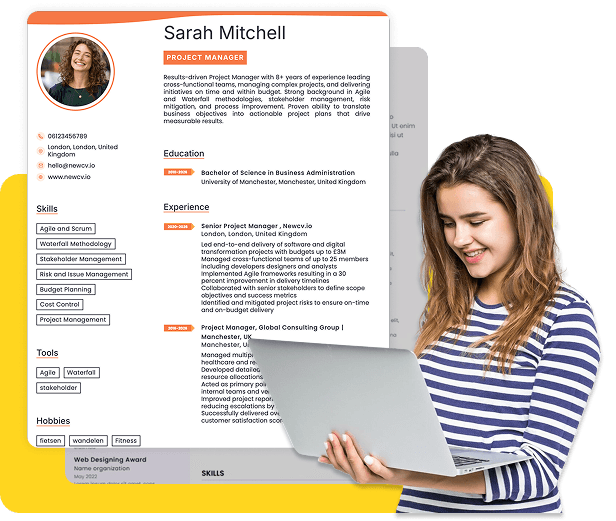
A Python developer resume fails for one of two reasons: it either looks technically shallow or it looks disconnected from real business impact. Most resumes list frameworks, tools, and buzzwords without proving how those technologies were used in production. Recruiters and engineering managers immediately notice the gap.
The biggest Python resume mistakes include vague backend experience, missing API performance metrics, overloaded skills sections, ATS-unfriendly formatting, and resumes that fail to match the exact stack in the job description. Another major issue is claiming experience with technologies the candidate cannot defend in technical interviews.
Strong Python resumes show measurable backend results, clear ownership, deployment experience, scalability work, debugging depth, and framework-specific expertise. Hiring managers want proof that you can build, maintain, optimize, and ship production systems, not just complete tutorials or list technologies.
Most Python developer resumes are written like task summaries instead of engineering impact documents.
Recruiters screening backend engineering resumes are looking for signals of production-level competence within seconds. If your resume reads like generic IT support, coursework, or keyword stuffing, it gets rejected before a technical lead even sees it.
The biggest problem is that candidates confuse “tools used” with “engineering contribution.”
A weak Python resume says:
Worked on Python applications
Used Django and PostgreSQL
Helped build APIs
That tells recruiters almost nothing.
A strong resume explains:
What systems were built
What scale they supported
What technical problems were solved
What measurable outcomes improved
What ownership the developer had
Modern engineering hiring is outcome-driven. Companies want developers who improve reliability, deployment speed, API performance, scalability, automation, or operational efficiency.
If your resume cannot prove that, it becomes invisible.
This is the fastest way to lose interviews.
Recruiters reviewing Python resumes often scan 50 to 150 resumes per role. Generic wording signals low-impact experience immediately.
Weak Example
Worked on backend development using Python
Responsible for APIs
Used Flask for web applications
Assisted with database tasks
These bullets fail because they lack:
Technical specificity
Scope
Architecture context
Metrics
Ownership
Business outcomes
They also sound interchangeable with thousands of other resumes.
Good Example
Built and optimized 18 REST APIs using FastAPI and PostgreSQL, reducing average response time by 37%
Migrated legacy Flask services to containerized microservices deployed on AWS ECS, improving deployment reliability and reducing release rollback incidents by 42%
Developed asynchronous data-processing pipelines with Celery and Redis handling over 4 million daily transactions
Implemented automated integration testing with Pytest, increasing backend test coverage from 51% to 87%
Strong bullets demonstrate:
Scale
Technical depth
Engineering ownership
Performance impact
Operational maturity
That is what engineering hiring managers want.
One of the biggest red flags in Python hiring is resumes overloaded with frameworks but lacking implementation detail.
Recruiters and senior engineers know many candidates copy popular stacks directly from job descriptions.
If you list:
Django
Flask
FastAPI
Celery
Kubernetes
Docker
AWS
but cannot explain how you used them, your resume becomes a credibility risk.
They want context.
Not just:
Django
FastAPI
But:
Built multi-tenant authentication flows in Django REST Framework
Designed async FastAPI endpoints for high-throughput payment processing
Used Celery for distributed background task orchestration
Implemented Docker-based CI/CD pipelines deployed via Kubernetes
The framework itself is not impressive anymore.
The implementation depth is.
Many technically qualified Python developers never reach human review because their resumes fail ATS parsing or keyword matching.
ATS systems do not “understand” your experience the way engineers do. They primarily evaluate structure, keywords, and role alignment.
Using graphics-heavy resume templates
Placing skills inside design elements or sidebars
Missing role-specific Python keywords
Using uncommon section titles
Uploading resumes in incompatible formats
Keyword stuffing without contextual usage
Failing to match backend stack terminology from job descriptions
Your resume should include:
Standard section headings
Clean formatting
Simple fonts
Clear technical stack sections
Role-specific terminology
Contextual keyword usage
For example, if the role mentions:
FastAPI
PostgreSQL
AWS Lambda
Docker
CI/CD
your resume should naturally reflect those terms inside real project bullets where applicable.
ATS systems increasingly evaluate semantic relevance, not just raw keyword repetition.
This mistake destroys technical interview performance.
Many Python developers treat the skills section like a collection checklist.
That backfires.
If your resume lists:
Kafka
Kubernetes
TensorFlow
Redis
GraphQL
Terraform
expect interviewers to test those areas.
Senior engineers specifically probe resumes for inflated claims.
They look for inconsistencies between:
Skills listed
Project depth
Bullet point sophistication
Technical explanations during interviews
If Kubernetes appears in your skills section but nowhere in your work experience, interviewers assume superficial exposure.
That damages credibility immediately.
Only include technologies where you can confidently discuss:
Real implementation
Tradeoffs
Problems solved
Architecture decisions
Production issues
Performance considerations
Depth beats breadth.
A focused backend Python stack with proven experience is stronger than a bloated list of trendy tools.
This is one of the most expensive mistakes in Python hiring.
A backend API engineer resume should not look identical to:
An AI engineer resume
A data automation developer resume
A Django full-stack role
A cloud platform engineer resume
Recruiters evaluate resumes against the exact hiring need.
Generic resumes lose relevance quickly.
Backend engineering roles prioritize:
APIs
Scalability
Databases
Performance optimization
Authentication
System architecture
Deployment reliability
Observability
If your backend resume lacks these signals, it appears junior or incomplete.
REST API optimization
Database query tuning
Async processing
Caching implementation
Load balancing support
Monitoring and logging
Deployment automation
Microservices architecture
Queue systems like RabbitMQ or Kafka
Generic scripting tasks
Unclear project ownership
No production metrics
No deployment exposure
No database optimization experience
Backend hiring managers care heavily about operational maturity.
This is one of the most overlooked Python resume mistakes.
Many developers focus entirely on coding features while ignoring the systems engineering side of backend development.
Modern Python hiring strongly favors developers who understand production environments.
They want evidence that you can maintain reliable systems, not just write code.
That includes:
Automated testing
CI/CD pipelines
Monitoring
Logging
Error tracking
Deployment automation
Infrastructure awareness
Incident debugging
Good Example
Built automated CI/CD pipelines using GitHub Actions and Docker, reducing deployment time from 40 minutes to under 8 minutes
Implemented centralized logging and observability using Prometheus and Grafana, improving production incident response speed by 46%
Increased backend reliability by introducing Pytest integration testing across critical payment services
These bullets immediately elevate a candidate above tutorial-level developers.
One of the biggest differences between average resumes and interview-winning resumes is measurable impact.
Most developers underestimate how important metrics are.
Engineering leaders care about outcomes.
Not just activities.
Strong backend metrics include:
API response improvements
Deployment frequency
Uptime improvements
Database performance gains
Automation impact
Processing throughput
Error reduction
Cost optimization
Infrastructure scaling improvements
Weak Example
Good Example
The second version demonstrates:
Technical understanding
Scale awareness
Performance optimization
Measurable business impact
That creates interview momentum.
Junior developers often struggle because they lack commercial experience.
That makes portfolio credibility even more important.
One of the biggest junior-level mistakes is submitting resumes with no proof of practical coding ability.
If you have limited professional experience, include:
GitHub profile
Backend projects
API projects
Deployment examples
Automation scripts
Technical documentation
Open-source contributions
Cloud deployment demonstrations
Not perfection.
They want signals of:
Real coding ability
Clean project organization
Readable documentation
Consistent commits
Practical functionality
Problem-solving mindset
A deployed FastAPI or Django application with authentication, database integration, Docker setup, and testing is far more valuable than 20 unfinished tutorial repositories.
Recruiters use ATS search filters aggressively.
If your resume lacks the right semantic terminology, you may never appear in recruiter searches.
The exact keywords depend on the role, but common high-value terms include:
REST APIs
FastAPI
Django REST Framework
Flask
PostgreSQL
SQLAlchemy
Redis
Celery
Docker
Kubernetes
AWS
CI/CD
Pytest
Microservices
Async programming
ETL pipelines
Observability
API integrations
Cloud-native applications
But context matters.
Keyword stuffing without implementation detail weakens resume quality.
Recruiters typically search combinations like:
Python AND FastAPI AND AWS
Django AND PostgreSQL
Backend Engineer AND Docker
Python API Developer
Python Microservices Engineer
Your resume should naturally align with these patterns.
Technical hiring prefers clarity over creativity.
Many candidates sabotage themselves with overdesigned resumes.
Multi-column layouts
Excessive icons
Skill bars
Graphics-heavy templates
Tiny fonts
Dense paragraphs
Inconsistent spacing
Color-heavy formatting
Resume templates built for designers instead of engineers
These layouts often fail ATS parsing and reduce readability.
Strong Python resumes are:
Clean
Scannable
Technically focused
Metrics-driven
Easy to skim in under 30 seconds
Recruiters prioritize clarity over aesthetics.
A simple resume with strong engineering depth beats a visually impressive resume with weak substance every time.
One of the most important signals in backend hiring is ownership.
Hiring managers want developers who can independently solve engineering problems.
Resumes that only describe assigned tasks feel passive.
Weak Example
Good Example
Ownership language changes recruiter perception dramatically.
It signals:
Initiative
Accountability
Technical confidence
Decision-making ability
These are major hiring signals for mid-level and senior Python roles.
A strong Python resume communicates five things immediately:
The candidate can build and maintain production systems.
The candidate improves measurable engineering outcomes.
The candidate matches the role’s technical environment.
The candidate understands deployment, testing, reliability, and debugging.
The candidate can defend every skill listed during technical interviews.
When those five signals are clear, interview rates increase significantly.
After reviewing thousands of engineering resumes, the strongest Python candidates consistently do these things well:
Quantify backend impact
Show deployment and production exposure
Tailor resumes to the exact role
Demonstrate API and database depth
Keep formatting ATS-friendly
Use strong action-oriented engineering language
Include cloud and observability experience where relevant
Avoid inflated technology claims
Show measurable scalability or automation outcomes
The best resumes make recruiters feel confident that the candidate can contribute in production quickly.
That confidence drives interview invitations.
Use ATS-optimised Resume and resume templates that pass applicant tracking systems. Our Resume builder helps recruiters read, scan, and shortlist your Resume faster.

Use professional field-tested resume templates that follow the exact Resume rules employers look for.
Create Resume
Use professional field-tested resume templates that follow the exact Resume rules employers look for.
Create Resume


 Upload Resume
 Import from Linkedin